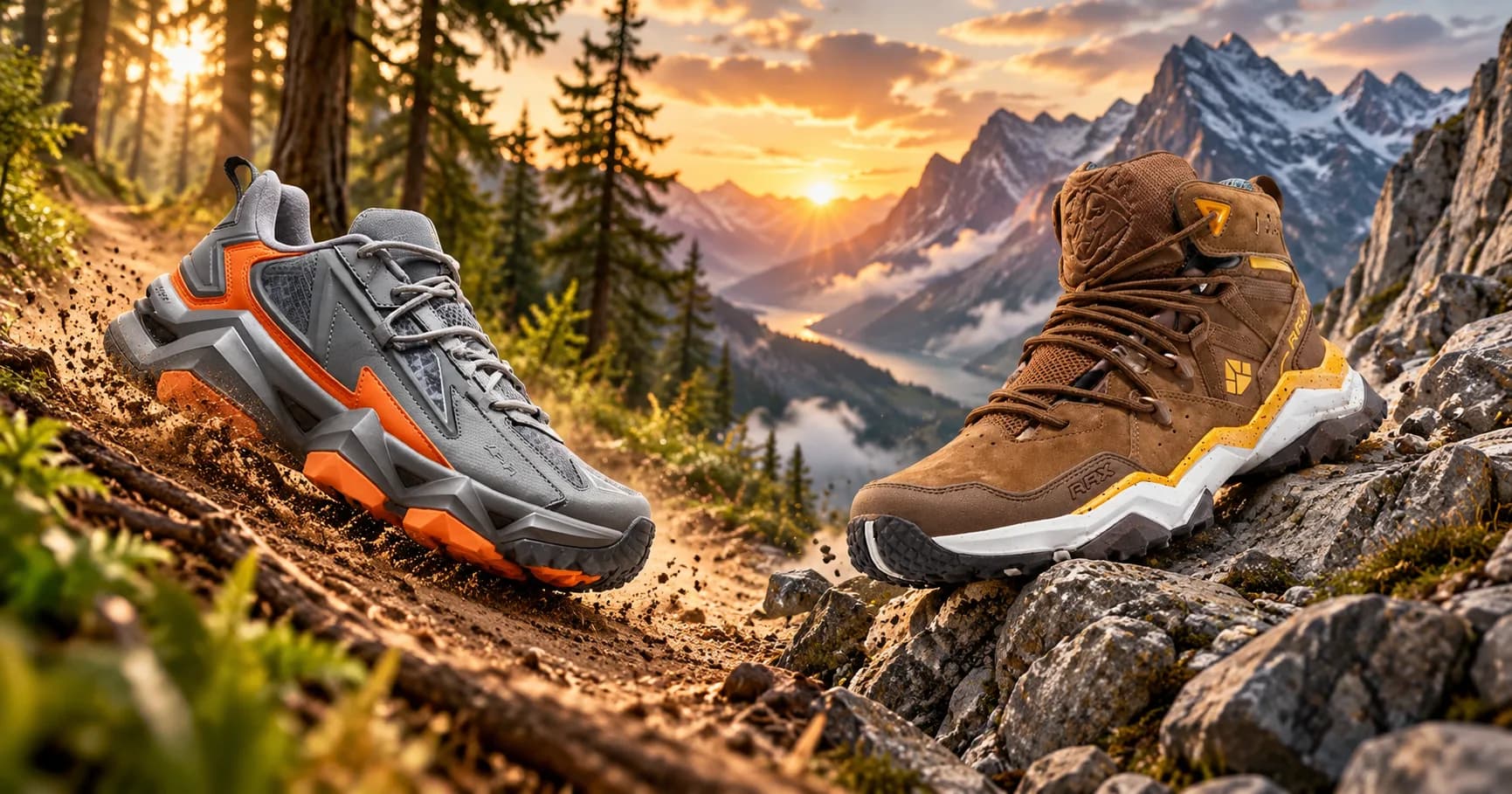
Hiking shoes are generally lighter and more flexible, while footwear sold for trekking is more often built around longer trips, rougher terrain and heavier loads. But there is no universal technical standard separating a “hiking shoe” from a “trekking shoe.”
The activities themselves overlap. ISO 3021:2023 defines hiking as less arduous than trekking, while trekking involves travel in a natural environment, includes at least one overnight stay and requires greater self-sufficiency. That helps explain why trekking footwear often moves toward more structure and protection, but the name printed on the shoe still does not tell you everything about its construction.
If you are choosing between the two, pay more attention to terrain, number of days, pack weight, sole stiffness, protection and fit than to whether the product title says hiking or trekking.
Hiking Shoes vs Trekking Shoes at a Glance
| Factor | Hiking Shoes | Trekking Shoes |
|---|---|---|
| Typical use | Short hikes and day hikes | Longer and multi-day routes |
| Terrain | Maintained to moderately difficult trails | Often rougher, steeper or more remote terrain |
| Pack weight | Usually light to moderate | Often heavier because overnight equipment may be carried |
| Weight | Often lighter | Often heavier |
| Flexibility | Usually more flexible | Often firmer underfoot |
| Protection | Moderate, depending on the shoe | Often greater emphasis on protection |
| Cut | Low-cut is common | Low, mid and high-cut models all exist |
| Best starting point | Day hiking and lighter trail use | Extended routes, heavier packs and demanding terrain |
These are typical differences, not rules. A substantial hiking shoe can be more supportive than a lightweight shoe marketed for trekking, which is why the individual specification matters.
When Does a Hike Become a Trek?
This distinction is useful because the footwear categories largely follow the demands of the activities.
Under ISO 3021:2023, trekking is more arduous than hiking and involves at least one overnight stay.
That means a trek often introduces requirements that may not exist on a short day hike:
- more food and water;
- overnight equipment;
- a larger backpack;
- more hours spent walking;
- several consecutive days on your feet;
- greater exposure to changing weather;
- more remote terrain.
The footwear does not suddenly change category at midnight on the first day. What changes is the amount of work being asked of it.
The Biggest Difference Is Usually Under the Foot
People often focus first on whether a shoe covers the ankle. The more meaningful difference can be the structure beneath the foot.
Lighter hiking footwear tends to flex more easily. That can make walking feel natural and reduce the amount of shoe you are carrying on straightforward trails.
Footwear intended for heavier loads or difficult terrain is often firmer. A stiffer platform resists twisting and bending more than a light trail shoe, which can become useful when footing is uneven or a heavier backpack is changing how much load you place through each step.
The American Hiking Society separates light trail footwear from heavier hiking boots in a similar way. Its guidance describes low-cut trail shoes as appropriate for easy to moderate hiking, while more substantial boots are recommended as terrain and pack weight increase.
Does Trekking Footwear Offer More Support?
Often, but “support” needs to be understood properly.
A trekking-oriented shoe or boot may provide:
- a firmer midsole;
- greater resistance to twisting;
- a more substantial upper;
- more protection around the sides or toes;
- a higher collar on some models.
That can make the footwear feel more stable under load.
It does not mean that every high-cut boot automatically provides better support than every low hiking shoe. The overall construction matters, including sole stiffness, heel hold, upper structure and fit.
Even within hiking footwear, the American Hiking Society distinguishes between low-cut trail shoes, light hiking boots and heavy hiking boots according to terrain and load rather than height alone.
Pack Weight Can Change the Answer
Consider two people walking exactly the same mountain trail.
The first carries water, lunch and a light jacket.
The second carries a tent, sleeping equipment, food, additional clothing and several days of supplies.
The route is identical, but the demands placed on the footwear are not.
The American Hiking Society recommends basic low-cut trail shoes for shorter hikes without a heavy pack or technical terrain, while more substantial footwear becomes appropriate for longer trips, difficult ground and heavier loads.
This is one reason “hiking vs trekking” is better treated as a spectrum rather than two sealed categories.
Hiking Shoes Are Usually Better for Lighter, Faster Movement
For a typical day hike on maintained trails, a lower-cut hiking shoe can offer an appealing balance of flexibility, traction and lower weight.
You may prefer this type of footwear when:
- you are carrying a small day pack;
- the route is well established;
- you are walking for a few hours rather than several days;
- you prefer a more flexible feel;
- you do not need a high boot for the expected conditions.
That does not make hiking shoes suitable only for easy trails. Some hiking shoes are built with substantial outsoles and protective uppers. The point is that the category generally includes lighter options than footwear intended specifically for long, heavily loaded journeys.
Trekking Footwear Makes More Sense as the Trip Gets Harder
A longer trek can justify more structure because small problems accumulate over several days.
A slightly unstable shoe may not bother you for two hours. After repeated descents with a heavier backpack, that same characteristic may become much more noticeable.
Trekking-oriented footwear becomes worth considering when:
- the journey lasts several days;
- you are carrying overnight equipment;
- the terrain is consistently uneven;
- there are long ascents and descents;
- the route is remote;
- you expect the shoe to take repeated abrasion;
- you want a firmer platform beneath the foot.
None of these conditions automatically requires a heavy boot, but together they explain why trekking footwear often becomes more substantial.
Trekking Shoes Are Not Necessarily Boots
This distinction is worth making because many comparison pages reduce the answer to:
Hiking shoes = low-cut
Trekking shoes = high-cut boots
That is inaccurate.
Both activities can be done in low, mid or high-cut footwear.
Low-cut footwear leaves the ankle uncovered and usually feels less restrictive. Mid-cut footwear provides additional coverage. High-cut boots extend farther above the ankle and are common in demanding or cold-weather footwear.
But collar height does not tell you how stiff the sole is, how much protection the upper provides or how securely the shoe fits.
Outsole Differences Matter More Than the Category Name
Outdoor footwear needs enough traction for the surfaces it will encounter. The American Hiking Society recommends looking for a tread that is deeper than ordinary running footwear and emphasizes traction as one of the main considerations when selecting hiking shoes or boots.
When comparing two pairs, inspect:
- lug depth;
- lug spacing;
- flexibility of the sole;
- coverage at the toe and heel;
- the surface conditions the footwear is intended for.
A shoe intended for hard-packed trails does not necessarily need the same outsole as footwear used repeatedly in mud, loose soil or rough mountain terrain.
Durability Becomes More Important on a Trek
Multi-day travel exposes footwear to more repeated flexing, abrasion and moisture than an occasional short hike.
That can make a more substantial upper attractive for trekking, particularly where the route involves rock, vegetation or repeated contact with rough surfaces.
The trade-off is usually weight and flexibility.
A heavier construction is not automatically more comfortable, and a lighter construction is not automatically less capable. It is a question of how much protection you need for the expected route.
What About Waterproofing?
Neither hiking nor trekking footwear is automatically waterproof.
Both categories contain waterproof and non-waterproof models.
The choice should depend on conditions.
Waterproof footwear can be useful for persistent rain, wet vegetation, shallow snow and similar environments. More ventilated footwear can be preferable in hot and relatively dry conditions.
For winter mountain conditions, footwear requirements become considerably more specific. Mountaineering guidance notes that winter boots are generally stiffer and that footwear should be selected according to terrain and underfoot conditions.
Do not choose waterproofing simply because the journey is called a trek.
Hiking Shoes vs Trekking Shoes for Different Trips
| Trip | Better starting point | Why |
|---|---|---|
| Two-hour local trail | Hiking shoes | Lower weight and flexibility are usually sufficient |
| Full-day mountain hike with a light pack | Hiking shoes or boots | Terrain becomes more important than duration alone |
| Weekend route with overnight gear | Hiking or trekking footwear | Choice depends on pack weight and terrain |
| Five-day mountain trek | Trekking-oriented footwear | Repeated use and heavier loads increase the value of structure |
| Long walk on maintained paths with a light pack | Hiking shoes may still work well | Distance alone does not require heavy footwear |
| Steep rocky route carrying substantial equipment | More structured footwear | Terrain and load create higher demands |
| Snow and ice requiring crampons | Appropriate winter or mountaineering boots | Ordinary hiking and trekking labels are no longer enough |
Can Hiking Shoes Be Used for Trekking?
Yes. A hiking shoe can work very well for a trek when its construction matches the route.
That is more likely when:
- the pack is light;
- the terrain is not extremely rough;
- you already know the shoe fits comfortably over long distances;
- you do not require additional boot height;
- the weather suits the shoe's construction.
The fact that a journey lasts several days does not make low-cut footwear unusable.
The real question is whether the shoe still provides the traction, protection, fit and stability needed after the trip becomes longer and the load becomes heavier.
Can Trekking Shoes Be Used for Hiking?
Yes. The trade-off is that you may be wearing more shoe than the route requires.
A structured trekking shoe or boot can be perfectly usable on a short hike, but it may feel:
- heavier;
- stiffer;
- warmer;
- less flexible.
If you regularly switch between short trails and multi-day trips, accepting that extra structure may be worthwhile.
If almost all of your outings are uncomplicated day hikes, a lighter hiking shoe may be the more comfortable everyday choice.
Fit Is More Important Than the Hiking or Trekking Label
A technically impressive shoe that does not fit your foot is still the wrong shoe.
Good outdoor footwear should hold the heel securely without repeated lifting, keep the midfoot controlled and leave room at the front for the toes.
The American Hiking Society recommends a firm heel hold, room at the toes and testing footwear while walking, including on an incline where possible.
Try footwear with the socks you plan to use and walk in both shoes before deciding. A longer trek makes fit problems more costly because rubbing or pressure that seems minor at first can become significant over repeated days.
Choose by Route, Not by Product Name
When two shoes are labelled differently, compare these seven things before deciding:
- Trip duration: hours, one day or several days.
- Terrain: maintained trail, mud, rock, steep ground or mixed surfaces.
- Pack weight: light day pack or overnight equipment.
- Sole structure: flexible or firm.
- Protection: how much upper and underfoot protection the route requires.
- Weather: dry, wet, hot, cold or snowy.
- Fit: secure heel, comfortable midfoot and enough toe room.
If those factors point toward low weight and flexibility, a hiking shoe may be the better choice. If the route calls for repeated days, rough ground, a heavier pack and more protection, trekking-oriented footwear becomes more attractive.
The distinction is not that hiking shoes are for easy walking and trekking shoes are automatically heavy boots. Hiking and trekking sit on the same outdoor-walking spectrum. The further the journey moves toward long duration, difficult terrain and heavier loads, the more useful additional structure and protection can become.
Comments
No comments yet.